When it comes to American hardwood furniture, few species are as well-loved as cherry and maple. Both have been used by furniture makers for generations and continue to be among the most trusted choices of materials for handcrafted furniture today.
Cherry is prized for its rich, reddish-brown color that deepens beautifully with age, while maple, lighter in color, is best known for its strength. Honestly, both are excellent options for furniture, which is exactly why we have them in our shop. Still, each wood species brings distinct qualities to the table, and it’s worth understanding those differences if you’re trying to decide between them.
Color and Grain: Cherry vs Maple
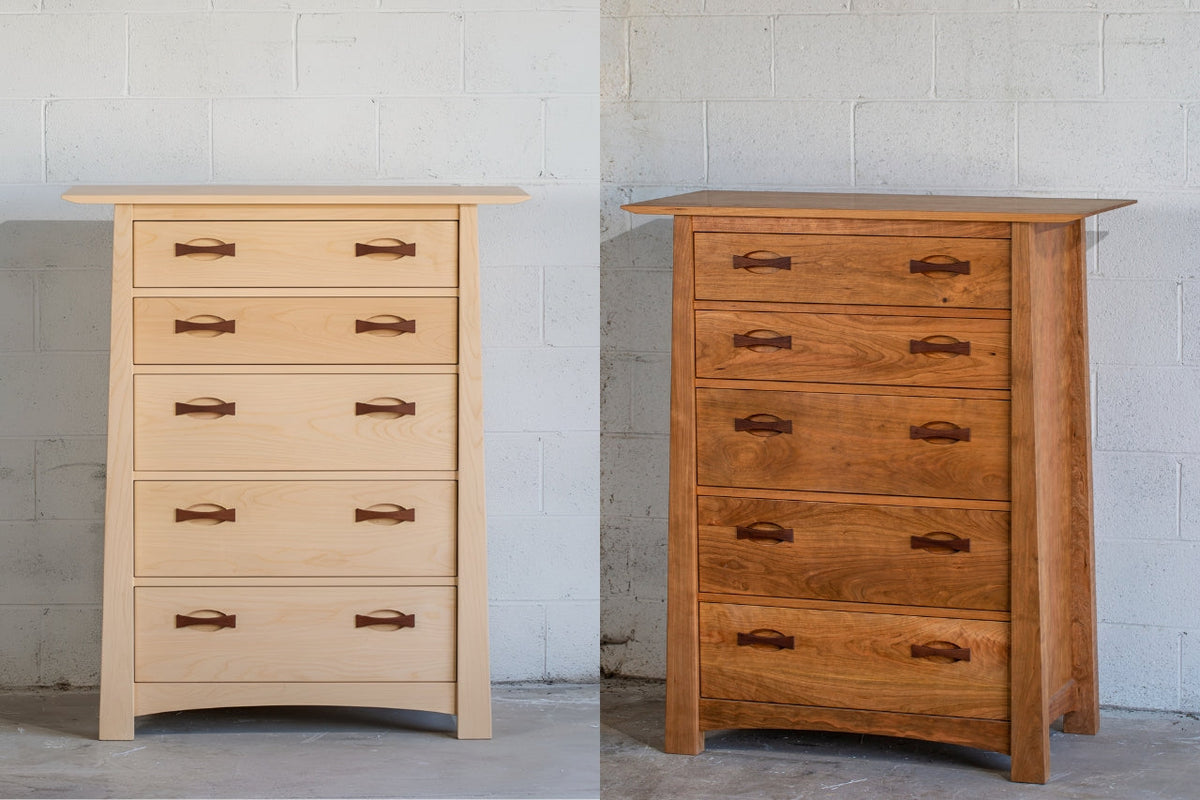
The cherry wood used in American fine furniture is Black Cherry (Prunus serotina). Freshly cut, it has a light, pinkish-brown color that gradually deepens into a deep reddish-brown as it’s exposed to air and light. The progression may take about five years, depending on direct sun exposure. In our shop, we mostly use kiln-dried cherry wood. The cherry piece you see on display in our showroom is already red-brown, perhaps only slightly lighter than the deep reddish-brown it eventually settles into.
Cherry typically has a straight grain, a fine, even texture, and a soft natural luster. Occasionally, you'll find figured boards with beautiful curly grain, but these are less common. Because of its color and texture, cherry is best finished with clear, natural finishes that emphasize its natural character and allow the wood to age gracefully.
Maple wood, meanwhile, comes in several species, but the one most often chosen for fine furniture is Hard Maple (Acer saccharum). The sapwood ranges from nearly white to a creamy off-white, sometimes with a subtle golden or reddish cast, while the heartwood is reddish brown. In fine furniture made of hard maple, the sapwood is the part mostly used.
Like cherry, maple also darkens with age, but the progression is much subtler, more gradual, and less dramatic than cherry. It settles into a light to medium brown in, perhaps, 20 years.
Hard maple typically has a straight grain, with a fine, smooth texture. But figured maple can feature stunning patterns, such as birdseye, curly, and quilted, which are prized in high-end, custom woodworking.
Cherry
Color & ToneWarm, reddish-brown color that naturally darkens with age
Grain & TextureTypically straight with fine texture and soft, natural luster
Hardness & DurabilityJanka rating of 950 lbf; moderately hard, easy to work with, dimensionally stable and resistant to warping, ideal for fine furniture
Maple
Color & ToneCreamy white to light beige that gradually develops a warmer tone
Grain & TextureFine and straight, with occasional birdseye, curly, or quilted figuring
Hardness & DurabilityJanka rating of 1,450 lbf; one of the hardest domestic hardwoods, ideal for high-traffic, high-use handcrafted furniture
Hardness and Durability: Cherry vs Maple
Cherry is a moderately hard wood, landing at 950 on the Janka hardness scale. That puts it in a comfortable middle range. It's sturdy enough for everyday use, yet still workable for craftspeople. Compared to harder domestic species like white oak, hickory, or hard maple, cherry might seem like the "softer" option on paper. But in the hands of a skilled furniture maker, cherry holds up remarkably well. It's notably stable, resisting warping and shrinking, which makes it a dependable choice for furniture meant to last for generations.
Hard maple, on the other hand, comes in at 1,450 on the Janka scale, making it one of the toughest domestic hardwoods available. That hardness translates to excellent resistance to everyday wear, which is why hard maple is such a strong choice for high-traffic furniture, such as dining tables, bed frames, or dressers.
Cost: Cherry vs Maple
Cherry has long been considered a premium hardwood, so it typically falls within the middle to upper price range among domestic species. Hard maple is generally moderately priced, although figured boards, such as birdseye, curly, or quilted maple, can have higher prices because of their unique appearance.
At our workshop, however, the price difference between cherry and hard maple is minimal, and they generally fall into a similar price range. For customers, the decision often comes down to the look and feel of the material rather than price.

Do you want to see how cherry compares to maple? Check out our wood sample kit and see the difference.
Best Style Pairings
Both cherry and maple can work beautifully across a wide range of interior styles. And honestly, the design of the piece sometimes matters more than the wood species itself. Clean and simple silhouettes allow both woods to blend naturally into nearly any space. That said, we’ve noticed some patterns in how people tend to gravitate toward each one.
Cherry is often linked to traditional furniture and pairs naturally with classic and transitional interiors. Some people perceive cherry as dated, but this influence may have stemmed from furniture stained to mimic reddish hardwoods like cherry or mahogany. They often feature a heavier look, often with a slightly magenta cast. Authentic cherry wood doesn't carry that heaviness. Its natural reddish-brown color brings a genuine warmth to spaces.
Maple's light color gives it an airy, understated look that's especially popular in contemporary, Scandinavian, and minimalist homes. It brightens a room naturally and pairs beautifully with various colors, which makes it a pretty versatile hardwood.
Cherry vs Maple: Which Hardwood Is Better for Furniture?
Honestly, both are excellent choices, and we wouldn’t say one outright beats the other. Any differences between them are minor at most. In the end, the decision really comes down to which color and aesthetic speak to you. Choose the one you’ll enjoy seeing in your home every day.
Cherry and Maple Wood FAQs
Is cherry wood outdated?
Not at all, though it’s understandable why some might think so. That perception usually comes from furniture that’s stained to look dark and heavy, often with a reddish-brown finish that leans slightly magenta, which is common in older furniture. Genuine cherry wood doesn’t have that look.
How do you make cherry wood furniture look modern?
Look for designs with clean lines and simple silhouettes. A timeless design reads as timeless whether it's crafted from cherry, maple, walnut, or white oak. If you already own cherry furniture and want to modernize the space around it, try leaning on neutral, cool-toned accents—rugs, curtains, and decor—to balance out the wood's reddish warmth.
Where can I find cherry and maple wood furniture?
You can find both at T.Y. Fine Furniture. We source cherry and maple right here in Ohio. All our pieces are handcrafted, with only one craftsman working on a piece from start to finish. And speaking of finish, we use our own signature wood finish, made from organic, food-grade ingredients, which help natural hardwood age gracefully.
What are the types of maple wood used for furniture?
Furniture is commonly made from either hard maple or soft maple species. Hard maple is the preferred choice for fine furniture because of its exceptional hardness and durability. Soft maple varieties, including red maple, bigleaf maple, and box elder, are also used, though they aren't as hard or wear-resistant.
Is maple a high-quality wood?
Yes, particularly hard maple. Soft maple varieties are more budget-friendly but don’t match hard maple’s strength and durability.
What's more expensive, maple or cherry?
It varies. Cherry can sometimes cost more to source. In our shop, though, the two are typically priced similarly.
Is maple cheaper than oak?
In most cases, yes. Hard maple is often slightly less expensive than white oak. However, prices can also vary based on the wood's grade, availability, and the specific type of furniture being built.