A bookcase is among the pieces of furniture in your home that changes often. New book titles get added, old favorites get pulled down and reread, and small treasures find their way onto the shelves over the years. The way it constantly evolves is exactly what makes styling a solid wood bookcase so different from decorating almost anything else in your home. But there are a few principles — more like tips, actually — that keep bookshelves feeling put-together. We’ve broken them all down in this bookshelf styling guide:
Let the Bookcase Set the Tone
Before you think about styling, look closely at the bookcase you’re working with because its design affects your styling decisions. A traditional solid wood bookcase with classic details often pairs beautifully with timeless accessories like vintage bookends, antique pieces, and leather-bound books. A minimalist bookcase, on the other hand, offers a clean backdrop and gives you more room to experiment. Clean lines are often read as neutral, which means the same bookcase can work in a farmhouse living room just as easily as a mid-century one.
Scale matters just as much as style. A bookcase that’s too small for your collection will always look packed, no matter how carefully you arrange it, while a large bookcase with too few items can feel sparse and unfinished unless, of course, you plan for that openness deliberately. When you’re shopping for a new piece or reconsidering the one you have, think about how much your collection is likely to grow.
Tips on Styling a Solid Wood Bookcase
Alternate Books with Decorative Vignettes
Instead of placing books across an entire shelf from end to end, divide them into smaller sections. Leave space between groups of books for decorative objects, like pottery or framed artwork, individually or in small groups. These vignettes give the eye somewhere to land and keep the whole shelf from reading as one long blur (unless, of course, this is the look you're going for).
Create Visual Triangles
An easy way to create the aforementioned vignettes is through triangular arrangements, as simple as stacking several books horizontally and placing a decorative object on top. Or, group three objects with varying heights to mimic a triangle.
Group Objects in Odd Numbers
Decorating with groups of three, or occasionally five, often feels more natural than perfectly symmetrical arrangements in even numbers. Vary the textures and heights within the group to make it more interesting.
Break Up the Pattern
A bookshelf doesn't have to be made up of rows of books standing perfectly upright. In fact, mixing up the arrangement is one of the easiest ways to create visual interest.
Try displaying some books vertically, stacking others horizontally, or turning a favorite book so its cover faces forward. You can even display a few books with the page edges facing outward for a softer, more textured look. These small changes help break up repetition and give your shelves a more dynamic feel.
You can also layer in artwork, framed photographs, or even vinyl records by leaning them against the back of the shelf. Place a smaller decorative object, such as a candle, sculpture, or vase, in front to add depth.
Choose bookends with personality. Bookends do double duty: providing functional support and adding texture and interest. Instead of plain, utilitarian designs, choose bookends that reflect your style. It could be a rock, a handcrafted wooden box, or a small sculpture, anything.
Add Plants
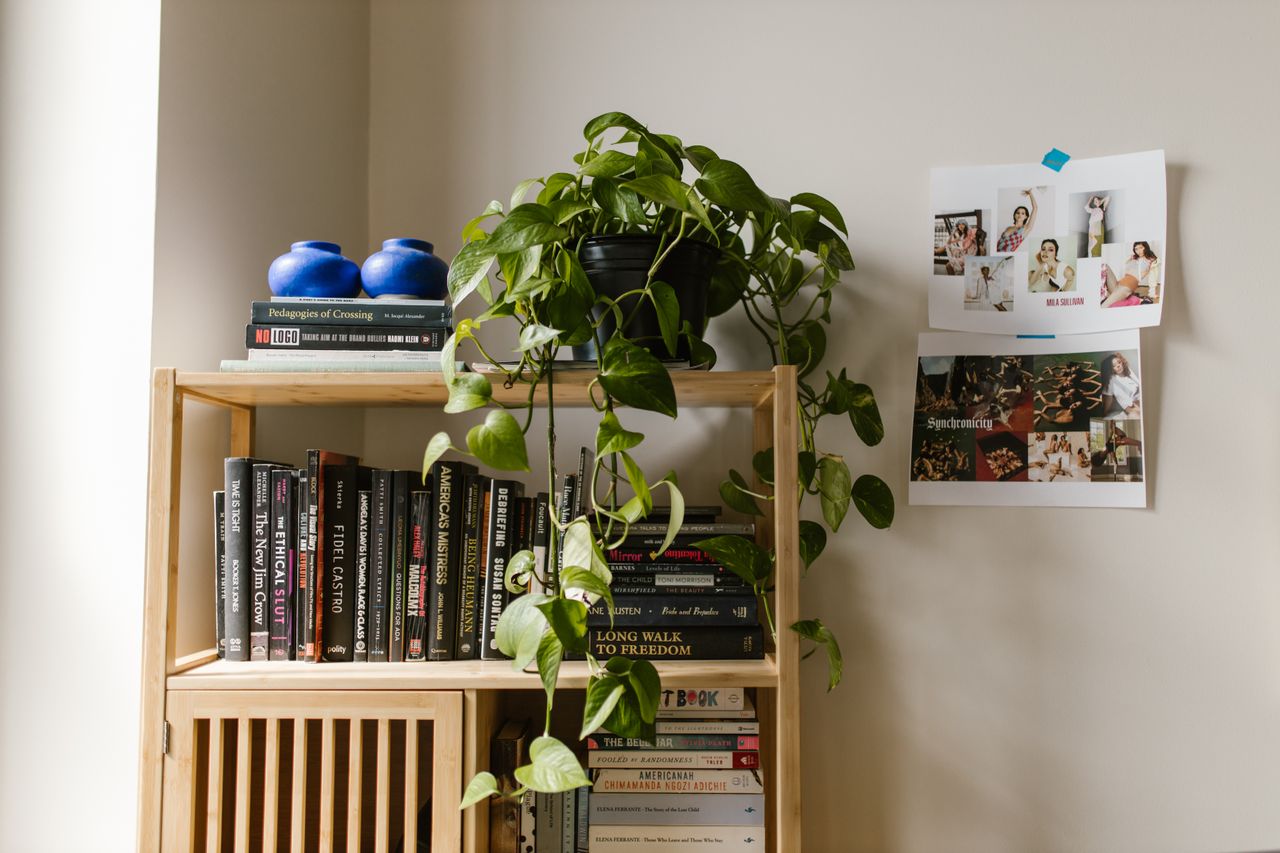
Plants bring softness to the straight lines of a bookshelf. Those that are trailing or cascading work especially well because they gently spill over the shelf, creating movement. They also introduce natural color and texture that beautifully complement solid wood furniture.
Repeat Accent Colors
Your décor doesn't have to match perfectly, but repeating colors creates cohesion.
If you display a brass sculpture, consider incorporating another brass accent elsewhere on the shelves. Likewise, if a decorative vase features deep blue tones, nearby books with blue spines can subtly reinforce the palette.
These small touches help everything feel thoughtfully arranged without looking overly coordinated.
Bookshelf Looks to Draw Inspiration From

The well-loved library. For serious readers, a full shelf is its own kind of beautiful. Paperbacks stacked above hardcovers, a pile of unread titles placed over the read ones, showcasing the spines worn from use, all from one end of the shelf to the other. This look isn't polished, but it's honest, and it tells anyone who walks in the room exactly what you care about.
The open, airy arrangement. If a cleaner look appeals to you more, embrace empty space rather than fighting it. Group books loosely, leave gaps between sections, and let a few larger pieces, like a big vase, a sculptural object, a stack of oversized art books, carry the visual weight instead of a dozen small trinkets.
The organized library. Some people find genuine satisfaction in a shelf with a clear system, whether that's by genre, author, or even color and size. Alternating upright rows with the occasional horizontal stack keeps a structured shelf from feeling too rigid, and small personal objects tucked into the gaps keep it from feeling too packed.
The calm, neutral backdrop. Sometimes the goal isn't to showcase the décor, but to bring the focus to the books. A neutral backdrop for a wall, paired with simple accents, helps reduce visual clutter, especially when displaying colorful book spines against richly grained wood.
A few more tips to get by:
✤ Avoid filling every inch of every shelf.
✤ Use a few larger decorative pieces instead of only tiny objects.
✤ Vary heights to create movement across the shelves.
✤ Display items that have personal meaning rather than decorating simply to fill space.
✤ Don't feel pressured to style everything at once, as bookshelves naturally evolve.
Complete your workspace, from shelf to desk. Explore home office furniture →
Your Bookcase Will Keep Changing
There's hardly any version of a bookshelf that stays "finished." New books eventually arrive, and the objects you display can change along with your life. Remember that the most beautiful bookcases aren't the ones that stay perfectly arranged forever. They're the ones that feel authentic, filled with books you'll actually read and objects that are meaningful to you, all of the details that reflect the people who live in the home. Start with a few of the tips above, adjust as you go, and let the shelf tell your story one addition at a time.
Featured Photo by RDNE Stock project from Pexels