What’s so good about leather furniture? Leather, as an upholstery material, improves with age. Unlike synthetic fabrics that deteriorate with daily use, leather conforms to your body and develops a gorgeous patina over time. You can enjoy all these, provided you source a piece from a furniture maker that uses high-quality leather.
The challenge is that “leather” has become a catch-all marketing term, particularly “genuine leather.” Without knowing what to look for in leather, it’s easy to pay premium prices for materials that don’t meet expectations. In this guide, we’ll help you navigate leather furniture by breaking down terms you’ll likely come across when you shop.
Common Terms in Leather Furniture
When comparing leather furniture, you'll come across terms like full grain, top grain, split, and genuine, often presented as a ranking from best to worst.
It's worth knowing what they mean, but they're not exactly an official grading system. Mostly, they describe which part of the hide was used, not how good the finished leather actually is. This nuance mainly applies to full-grain and top-grain leather.
Full-grain leather is often marketed as the highest-quality option; however, even a full-grain hide can vary in quality if the tannery did not adhere to proper processing standards. On the other hand, top grain leather–despite its name–does not automatically signify that it is of inferior quality or that it is simply second to full grain. In fact, high-quality top grain leather from a reputable tannery can be competitive with, or even superior to, full grain leather.
Real quality comes down to the hide itself, how it was tanned and finished, the dye or pigment quality, and the reputation of the tannery or furniture maker. This is why brand-specific grading tends to be a more reliable signal than the generic terms alone.
Leather Grades
Full Grain. This leather comes from the outermost layer of the hide that hasn’t been heavily sanded, buffed, or corrected. Because hardly anything has been done to alter this layer of the leather, much of the natural character of the material is preserved.
Top Grain. Like full-grain leather, the top grain comes from the outermost layer of the hide. The main distinction comes down to the processing. Top-grain leather is lightly sanded and buffed to shave down scars, brands, and insect bites. This process creates a more uniform surface texture, though some natural characteristics of the leather may still peek through.
Split Leather. This part comes from the lower, looser layer left over after the top layer is split away. It is the fibrous layer beneath the top grain, where genuine suede actually comes from, but may be coated and finished to resemble top-grain leather. Some manufacturers use this part to cover less visible areas of the furniture.

Close-up of assorted multicolored leather rolls in a craftsman workshop setting. Photo by Vlada Karpovich from Pexels
You may also come across these terms:
Corrected Leather. This refers to leather in which the natural surface has been sanded or buffed to remove scars, brands, insect bites, and other imperfections, then usually embossed with an artificial grain pattern and/or given a heavier finish coat to even out the look. It's not a separate "grade" so much as a description of a process.
Bonded Leather. This is made using leather fibers or scraps combined with binding materials. It is different from upholstery covers made from a continuous section of natural hide.
Color and Finish Process
Aniline. Aniline leather is soaked in soluble dyes with no surface sealers or a layer of pigment. Because there is no topcoat to cover flaws, only the best full-grain hides with minimal to zero defects are used. This process yields leather that is exceptionally soft and supple, with the hide’s natural character intact. However, because it lacks an additional protective layer, aniline leather requires more care and attention, as it is vulnerable to staining, fading, and scuffing.
Semi-Aniline. The leather goes through a deep-dye process similar to pure aniline, but a final layer of lightly pigmented protective coat is added. This seals the pores just enough to provide some protection from spills, stains, and fading while creating a more uniform color across the surface. It also retains much of the hide’s natural character and softness.
Pigmented. Pigmented leather uses a heavy, opaque coat applied directly over the hide to seal and color the surface. This layer masks flaws while providing higher resistance to damage from daily use. Aside from better protection, the color is more consistent across the surface but trades away the natural texture and the developing patina characteristic of full-aniline leather.
| Leather Finish | Protection | Maintenance |
|---|---|---|
| Aniline | Lower | Higher |
| Semi-aniline | Moderate | Moderate |
| Pigmented | Higher | Generally easy |
Read: Do You Need to Condition a Leather Couch?
Genuine Leather
Sometimes, when you shop for leather furniture, you may come across descriptions like “genuine” leather or “100% leather”. Genuine technically just means real, but it carries a reputation as a low-grade label compared to full-grain or top-grain leather. The main reason for this is that low-quality leather is sometimes stamped simply as "genuine leather" made of splits, the second layer of the hide, coated in a polyurethane-based finish to mimic top-grain leather.
For a furniture buyer, "genuine leather" on its own isn't automatically a dealbreaker, but it reveals very little of the material. What actually matters is knowing whether you're looking at full grain, top grain, or split leather, and how it was processed.
So rather than asking only, "What grade is this leather?" it is more useful to ask:
✦ What part of the hide is being used?
✦ Has the surface been corrected or altered?
✦ How has the leather been dyed and finished?
✦ How much protection does the leather have?
✦ How will it perform in the environment where I plan to use it?
✦ Who manufactured the leather and furniture?
✦ These questions will give you a much better picture of what you're buying.
How Brands Grade Their Leather
Most manufacturers use their own internal grading systems–usually designated by letters or proprietary names–to mark price and quality tiers within their own catalogs.
Stressless grades its leather lineup under names like Batick, Paloma, Noblesse, and Velaro, each offering a distinct feel, level of finish, and price point.
American Leather uses a named and lettered scale: Leather C (Titan), Leather D (Bali, Capri), Leather F (Bison, Dolce, Umbria), and Leather G (Axel, Elmosoft), where the letter reflects the leather quality and cost tier.
Our team can walk you through the best upholstery cover options. Visit any of our two showrooms today. →
Quality of Materials in Frames
It's easy to focus on the upholstery since that's what you touch and see first. But the frame underneath is just as important. As the foundation of the piece, it's a crucial factor in how well the furniture holds up and how long it lasts, long after the leather has broken in.
Frame construction varies by brand and by piece:
✦ American Leather builds its frames from kiln-dried hardwood, which resists warping and holds joinery tightly over years of use.
✦ Fjords uses engineered steel frames in its recliners, built for the repeated motion recliners go through.
✦ Stressless relies on robust steel framing for the core structure of its recliners. Its sofas typically use solid European beech or laminated (molded) beech wood combined with cold-bent steel for added strength and flexibility.
When you're considering a leather sofa or recliner, ask about the frame the same way you'd ask about the leather. A beautiful hide on a weak frame won't hold up nearly as long as a modest leather on a well-built one.
Read: Best Recliners in Columbus: Stressless vs Fjords vs American Leather
Things to Consider Before Buying
Sofas, recliners, and chairs with leather covers offer some real advantages. The material stands up well to daily wear, resists stains better than most people expect (especially with protective finishes), and, depending on the leather, can last for decades with the right care. There's also something undeniably luxurious about it: the feel, the smell, the way it conforms to your body as it ages.
However, leather isn't the right fit for every home, and it's worth going in with eyes open before you invest:
✦ Comfort. Leather can feel warm and a little tacky in hot weather, as it offers less airflow and traps more heat than most woven fabrics.
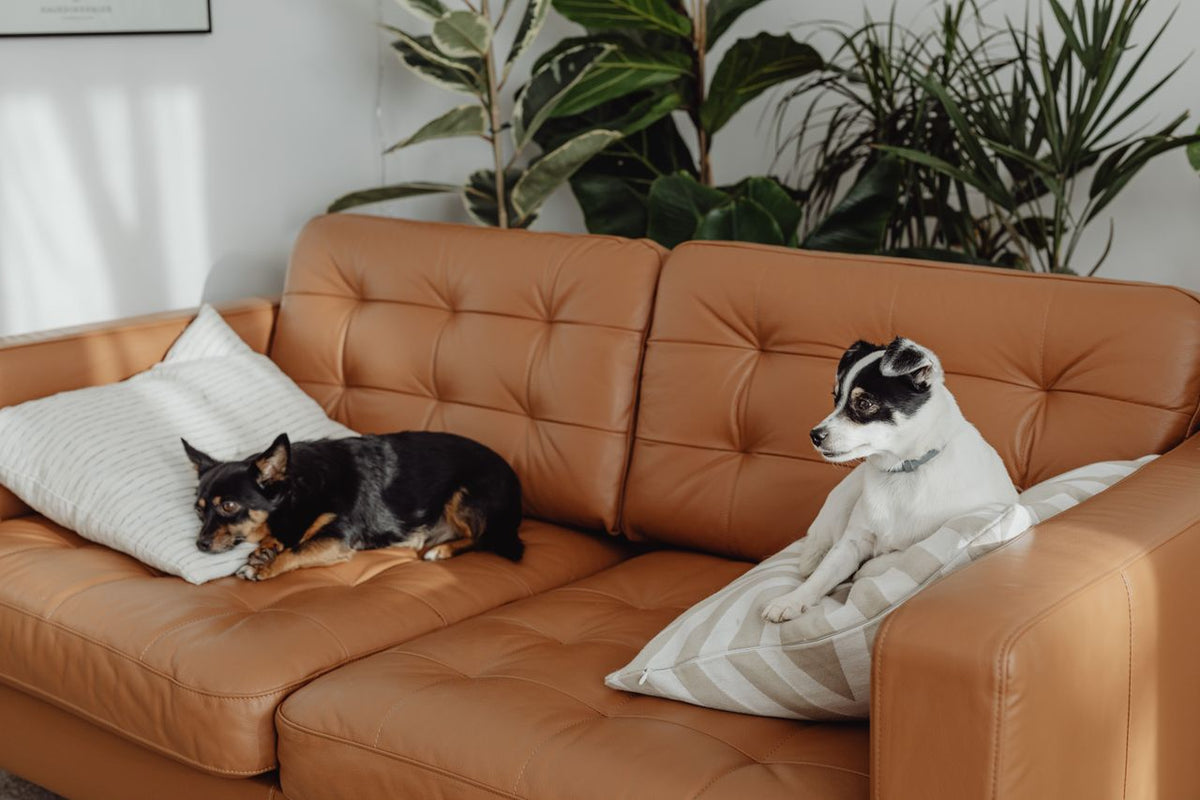
✦ Scratches. Pets with sharp claws can leave marks that are hard to undo.
✦ Cost. Real leather typically costs more upfront than most fabric alternatives.
✦ Maintenance. It needs regular conditioning to stay supple and avoid cracking over time.
Featured Photo by https://kaboompics.com/ from Pexels