There’s something deeply satisfying about owning a piece of furniture you know will still be around decades from now. A solid wood dresser, chosen wisely, can be exactly that. But not all “solid wood” dressers are created equal, and knowing what to look for as you shop for one can save you from a costly mistake. To help you find the right piece for your bedroom, here’s our solid wood dresser buying guide:
1. Choose Hardwood, Not Just Any Wood
When it comes to furniture material, hardly anything beats hardwood, especially for a piece subjected to daily traffic like a dresser. Drawers are repeatedly pulled open and pushed shut, and any hardware is under constant stress; through it all, the frame needs to remain stable for years. Hardware simply handles this level of everyday wear better than any type of wood.
Technically, softwoods such as pine, cedar, and fir are still considered solid wood. But if you envision your dresser as durable and long-lasting, hardwood is usually the better investment.
Some of the best hardwoods for heirloom-quality bedroom furniture include:
✤ Cherry is one of the most popular domestic hardwoods, widely known for its warm, reddish-brown color that deepens beautifully over time.
✤ Walnut is highly prized for its gorgeous, dark brown heartwood, which often features subtle hints of purple, grey, or reddish streaks.
✤ Hard maple is one of the hardest domestic hardwoods available, best recognized by its clean, light, and creamy color profile.
✤ White oak offers remarkable structural strength, a neutral light brown color with prominent ray flecks, and natural moisture resistance.

These woods are naturally denser and more resilient than most softwoods, making them less prone to dents, warping, and long-term structural fatigue.
That does not mean softwood furniture is inherently low quality. Well-crafted pine pieces can last for decades, and certain softwoods are uniquely suited for specific parts of a dresser. Cedar, for example, contains natural oils that repel moths and resist mildew, making it an excellent choice for drawer linings. It keeps fabrics fresh while adding the rich, nostalgic aroma often associated with heirloom-quality furniture.
Still, for the primary structure of a highly functional piece of furniture like a dresser, something you'll likely use every day for decades, hardwood offers a noticeable advantage in durability and stability.
2. Make Sure It’s Actually Solid Wood
One of the biggest mistakes in furniture shopping is assuming that “wood furniture” automatically means solid wood furniture.
Many dressers today are made with particleboard or engineered-wood core and topped with a thin veneer or plastic laminate. While some veneers can look convincing at first, these composite materials rarely age with the grace and stability of genuine solid wood. Over time, laminates and veneers can chip, peel, bubble, or separate, especially on surfaces that are constantly used.
So how can you tell if a dresser is truly solid wood?
The simplest trick is to look for end grain.

Real solid wood reveals the tree's natural growth rings and fiber patterns where the board was cut across its width. Because this multidirectional grain pattern is nearly impossible to fake convincingly, engineered alternatives usually hide their composite core by wrapping long-grain veneer strips all the way around the edges.
Inspect areas manufacturers often hope customers won’t examine closely:
✤ Look closely at the edges of the drawer. If the wood grain pattern continues perfectly over the edge like it’s wrapped around the surface, it’s likely veneer or laminate. Solid wood usually shows end grain or a natural change in grain direction at the edges.
✤ Check the back and underside for raw particleboard. Examine the back panel of the dresser and the frame's underside. Manufacturers rarely waste expensive veneer on surfaces facing the wall or the floor, often leaving the telltale rough texture of engineered composite completely exposed.
✤ Inspect the structural supports. Look at the internal divider rails between drawers or the support components underneath. In mass-produced furniture, these structural pieces are frequently made of cheap, unfinished plywood or MDF, whereas heirloom pieces use the same wood throughout or secondary solid woods like poplar or pine.
3. Inspect the Construction and Joinery
Choosing the right wood is only half the equation. Without skilled craftsmanship, even the most beautiful material goes to waste.
One of the first places to inspect is the drawer box construction.
Many shoppers immediately look for dovetail joints because they’ve long been associated with quality furniture. And while hand-cut dovetails can absolutely be a sign of excellent craftsmanship, factory-made dovetails are not automatically superior.

Fresh from the workshop: The Enso Dresser. A quick look behind the drawer fronts reveals 100% solid wood construction and clean, traditional joints.
Poorly executed dovetails can actually become weak points if the joints aren’t precise. If the pins and tails aren’t cut accurately or sanded flush with each other, the joint may loosen over time or even separate under repeated stress.
Instead of focusing only on whether a drawer has dovetails, pay attention to the overall quality of the joinery:
✤ Are the joints tight and clean?
✤ Do the drawer corners feel sturdy?
✤ Are there visible gaps or uneven sanding?
✤ Does the construction feel solid when opened fully?
Good craftsmanship tends to reveal itself in consistency and precision.
4. Test the Drawer Mechanics
A dresser may look beautiful on the showroom floor, but if the drawers don’t function properly, daily use quickly becomes frustrating.
Open every drawer fully. Then close them again slowly. The movement should feel smooth, stable, and controlled, not loose, wobbly, or resistant. Drawers should glide naturally without scraping, sticking, or shifting side to side.
If the dresser uses soft-close hardware, test whether it performs properly. High-quality soft-close systems should guide the drawer gently shut without slamming or requiring excessive force.
This may seem like a small detail, but drawer mechanics often reveal a lot about the overall quality of the furniture. Cheap slides and poorly aligned hardware tend to fail early, especially in furniture that sees constant use.
5. Don’t Overlook the Finish
The finish is one of the most overlooked aspects of solid wood furniture. A high-gloss shine doesn’t automatically mean high quality, and a matte finish isn’t necessarily less refined.
A few things are worth paying attention to:
✤ Smell the piece. A strong chemical odor can indicate heavy VOC off-gassing from lower-quality finishes. A well-finished dresser should have little to no noticeable smell.
✤ Look closely at the surface. Quality finishes should appear smooth and even, without visible brush marks or cloudy buildup. Hand-rubbed finishes, in particular, allow the natural grain and texture of the wood to remain visible, giving the piece warmth and depth rather than a thick, coated appearance.
✤ Feel the wood. A well-applied finish should feel smooth and natural to the touch, not overly thick or plasticky. The best finishes enhance the character of the wood instead of hiding it.


6. Consider the Size of Your Room and Existing Furniture
A beautiful dresser still needs to work comfortably within the space you already have.
Before committing to a piece, measure your bedroom carefully, especially if it already contains large furniture like a bed, nightstands, or an armoire. A dresser that looks perfectly proportioned in a showroom can feel overwhelming once it's inside a smaller room.
Think about clearance first. You should be able to walk through the room comfortably and open drawers fully without bumping into the bed or surrounding pieces.
Visual balance matters too. A large, heavy dresser beside a small bed frame can make a room feel crowded; one that's too narrow may feel out of place next to more substantial pieces. In some cases, a taller chest trades floor space for storage, a worthwhile swap in a room where square footage is limited.
The goal isn't to fit in the largest piece possible. It's to create a room that feels functional, balanced, and easy to move through.
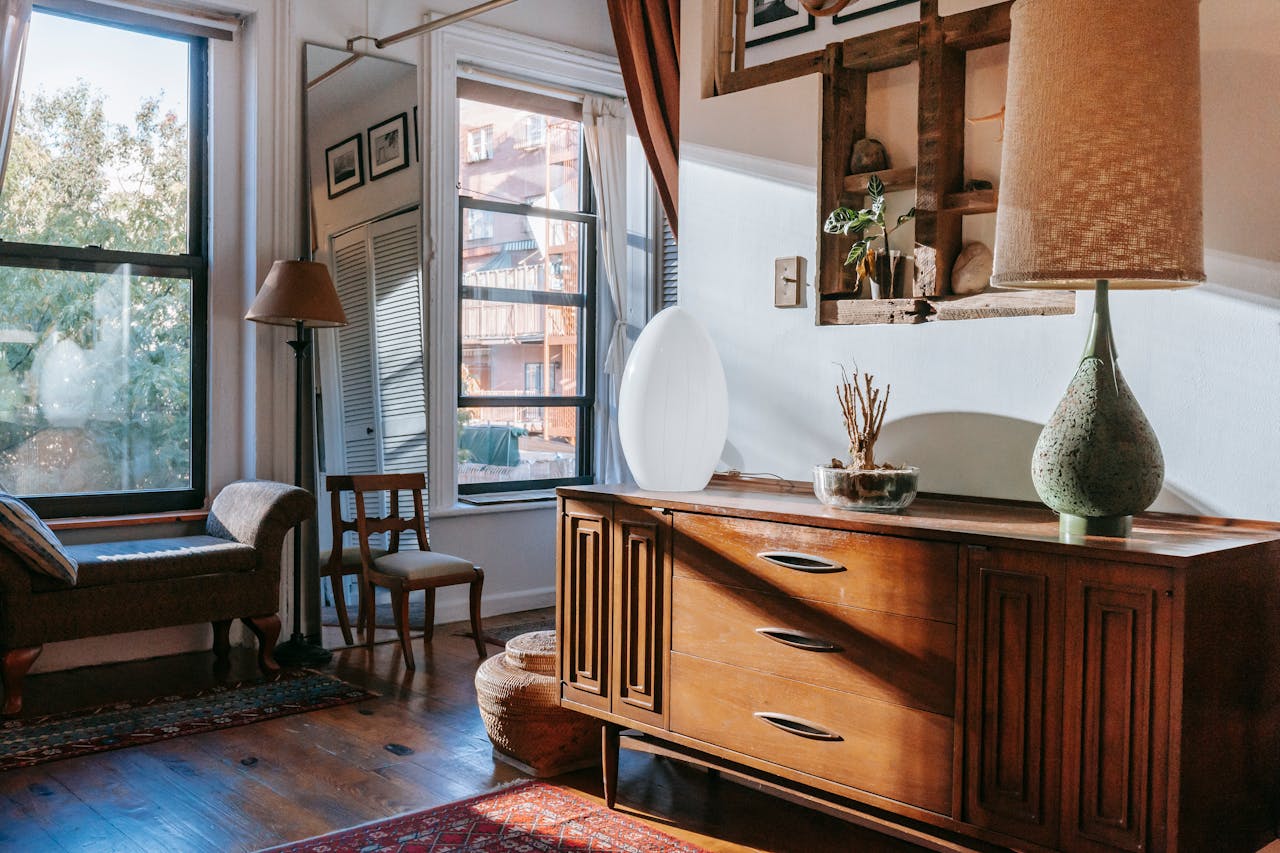
Featured Photo by Charlotte May from Pexels