The best Japanese-inspired beds do less, and do it better. Here's what defines the style, and how to tell a well-made one from a look-alike.
Search for a Japanese bed frame and you'll find hundreds of low wooden platforms. Some carry the idea well. Most borrow the look and skip the thinking behind it. Japanese bed design isn't a silhouette. It's a set of choices about height, material, joinery, and restraint, and every one of them shows in how a bed feels to live with.

1. Sleep closer to the ground
For centuries, Japanese homes had no bed frames at all. People slept on futons laid over tatami mats, then folded them away each morning so the room could be used for something else. That habit shaped the modern Japanese-inspired bed: it sits low, keeps a small footprint, and lets the room feel open.
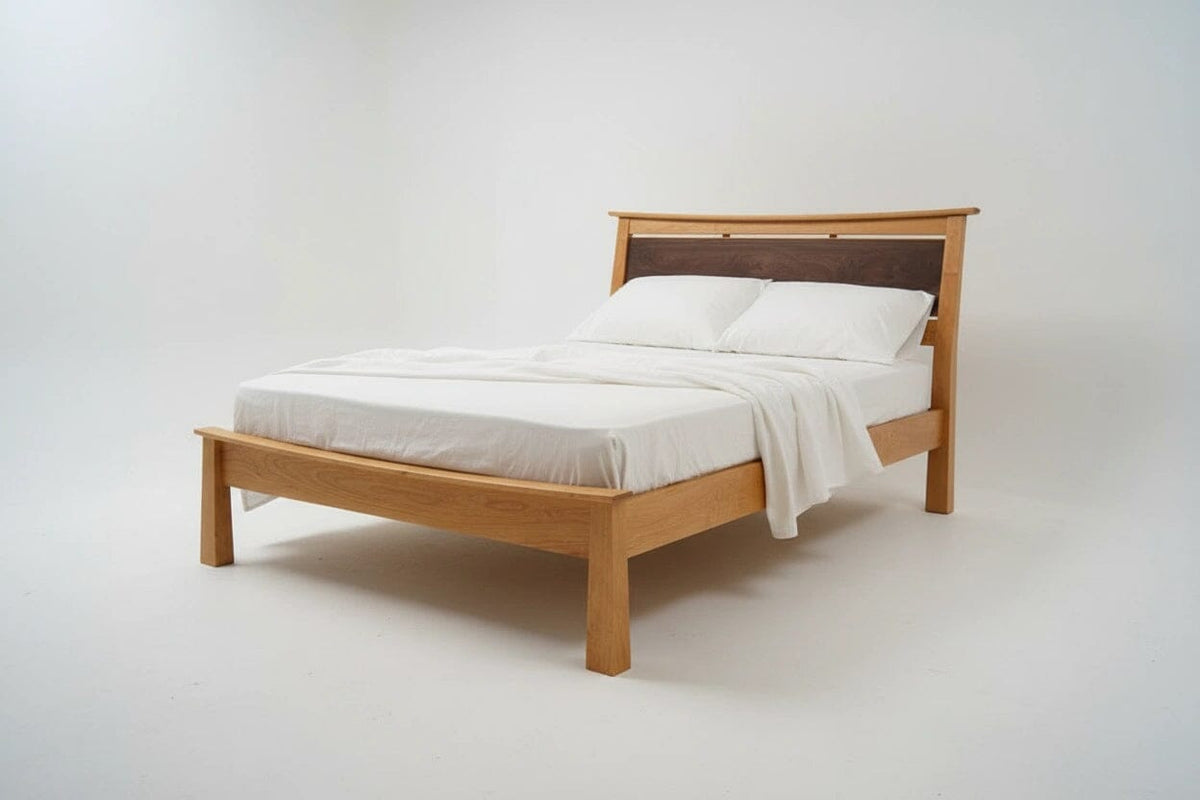
A low bed changes how a bedroom reads. Walls feel taller. Windows feel bigger. The room feels calmer because nothing towers over it. Our Horizon Platform Bed sits on an 8.5-inch platform with 7 inches of clearance underneath: low enough for that grounded feeling, high enough that getting up in the morning isn't a workout.
2. Let the wood be the decoration
Japanese design treats natural material as the ornament. There's no carving for its own sake, no painted finish hiding the grain. The wood's color, figure, and texture carry the piece.
That's why stain doesn't belong on a Japanese-inspired bed. Stain flattens grain and fixes a color in place. We never stain our wood. A cherry bed is cherry, a walnut bed is walnut, and each one changes over the years: cherry deepens to a rich reddish-brown, white oak warms toward gold. The finish is our zero-VOC blend of food-grade oils and waxes, which soaks into the wood instead of sitting on top of it, so the grain stays something you can see and feel.
3. Joinery you can trust
Japan has one of the richest woodworking traditions in the world. Sashimono, the craft of fitted furniture joinery, and kigumi, the interlocking joinery of timber buildings, both come from the same idea: a joint should be strong because of how it's cut, not because of how many screws hold it together.
We build to the same standard. Our beds use traditional mortise and tenon joinery reinforced with stainless steel dowels, and the slats bolt in rather than resting loose, so the bed stays quiet for decades. No cam locks, no pocket screws. Our Sunrise Platform Bed takes its inspiration directly from sashimono.
4. Wabi-sabi: beauty that ages
Wabi-sabi is the Japanese idea that beauty lives in things that are simple, natural, and changed by time. A worn step, a cup with a slightly uneven rim, a table that has darkened where hands rest on it.
Furniture built for wabi-sabi needs two things: honest materials and a finish that lets them age. Solid hardwood develops patina; veneer and particle board just wear out. An oil-and-wax finish can be refreshed and spot-repaired; a plastic film finish chips and has to be stripped. A bed built this way looks better in year twenty than in year one.
5. Restraint and empty space
The Japanese concept of ma is about the value of empty space, the pause between things. In a bedroom, that means fewer pieces with more room around them, and furniture shapes quiet enough to let the room breathe.
For a bed, restraint shows in the headboard. Gentle curves instead of ornament. Horizontal lines that echo the low profile. Proportions that look calm from across the room.

Japanese, Japandi, or both?
You'll often see "Japandi" alongside Japanese bed design. Japandi blends Japanese restraint with Scandinavian warmth and practicality: the same natural wood and clean lines, with a little more softness and everyday function. In practice, a well-designed Japanese-inspired bed fits either style. The difference is mostly in the rest of the room: bedding, textiles, and how much you leave on the walls.
How we interpret it: the Horizon and the Enso
We design two beds around these ideas, for two ways of using a bedroom.
The Horizon blends Japanese architecture with Shaker simplicity. Its headboard is shaped with horizontal lines and gentle contours, and it sits low and grounded on an 8.5-inch platform. The headboard adjusts to 36 or 40 inches to suit your mattress. It's available in cherry, walnut, white oak, and hard maple.
The Enso takes its curves from the Myojin torii, the gates that mark the entrance to Shinto shrines. It stands a little taller, on a 12-inch platform, and its 44-inch headboard leans back slightly for reading or watching TV in bed. It's available in cherry and walnut.
Both are built by hand in our Columbus, Ohio workshop from FAS and Select grade hardwood, matched board by board for grain and color, and both carry our lifetime structural guarantee.
Compare the Horizon and Enso side by side →
What to look for in any Japanese-style bed
- Solid wood throughout. Veneer over particle board can mimic the look but won't age the way the style intends.
- Real joinery. Ask how the frame and slats are joined. Cam locks and loose slats creak; bolted joinery doesn't.
- An honest finish. Unstained wood with a penetrating oil finish lets the grain show and the patina develop.
- The right height for you. Floor-level looks striking but isn't for everyone. Seven to ten inches of clearance keeps the low profile and the easy morning.
- A frame that fits your mattress. Headboard height should suit your mattress thickness, or the proportions fall apart.
Not sure which wood suits your room? Order wood samples and see the grain in your own light, or visit our Clintonville or Grandview showroom to try both beds in person.
More on furniture styles and how to live with them in our Style Guide.