Natural cherry wood is one of the most valuable hardwoods for furniture in the United States, and by far one of the most popular choices among clients here at T.Y. Fine Furniture.
It's easy to see why cherry wood continues to be a favorite among furniture makers and homeowners alike. It's a durable hardwood with a beautiful reddish-brown color that brings warmth to any space. That natural color is what makes cherry unique from other popular hardwoods like walnut, maple, and white oak. While all of these woods change color as they age, none transform quite as dramatically as cherry.
To truly appreciate cherry wood's beauty, let's take a closer look at its color, grain, and other unique traits that set it apart in the world of furniture making. Read on to learn more about this hardwood.
Black Cherry Tree Traits
In the US, cherry wood commonly refers to Black Cherry or American Cherry (Prunus serotina), a tree native to North America known for its beauty and versatility.
Black cherry trees stand tall and proud, reaching 50 to 80 feet with a lush spread of 30 to 40 feet wide, and a trunk growing to about five feet thick. These beauties flourish in forests, woodlands, and even along roadsides across the continent.
Bark
The black cherry tree's bark changes as it matures, transitioning from smooth and greenish-brown with lenticels to rough and black with large, broken flakes.
Leaves
The leaves are oval-shaped with finely serrated edges, measuring between 3 and 6 inches in length and 1 to 1.5 inches in width. They have a dark green, shiny upper surface and a lighter underside. During autumn, the leaves display vibrant hues of yellow, orange, and red.
Fruit
The most recognizable trait of the black cherry tree is its fruit. Dark red or black cherries that ripen in late summer and early fall, about half-inch in diameter, grow in drooping clusters. Although birds love them, it's important to remember that the fruit and other parts of the black cherry tree are toxic to humans and some animals.
Features of Natural Cherry Lumber
Cherry wood is highly valued for furniture making and woodworking due to its beautiful color and unique grain patterns. Here's a breakdown of its traits:
✱ Color
Natural cherry wood is known for its warm, reddish-brown color and the fascinating way it transforms over time. Freshly cut, cherry wood has a pinkish brown color, then it gradually deepens to a medium reddish brown with more exposure to light and oxygen.
In about six months, the color of cherry wood begins to warm noticeably. This maturation process may take about five years, when the color settles into the warm red-brown that cherry is known for. Keep in mind that the progression and actual color of cherry may vary with lighting, grain, and direct-sun exposure.
Cherry lumber can also vary in color depending on the cut: heartwood (the tree's inner core) tends to run darker than sapwood (the outer layer).
✱ Grain
Cherry typically features a fine, straight grain, although some pieces may be figured and break pattern through waves and curls. While the baseline grain runs smooth and straight, individual boards often show natural character in the form of pith flecks, mineral deposits, gum pockets, or the occasional small knot.
✱ Durability & Workability
Cherry is a hard, durable wood with a Janka hardness rating of 995. This makes cherry furniture resistant to scratches and dents, and capable of lasting for generations with proper care. It is relatively easy to work with for experienced woodworkers—it cuts, planes, sands, and glues well.

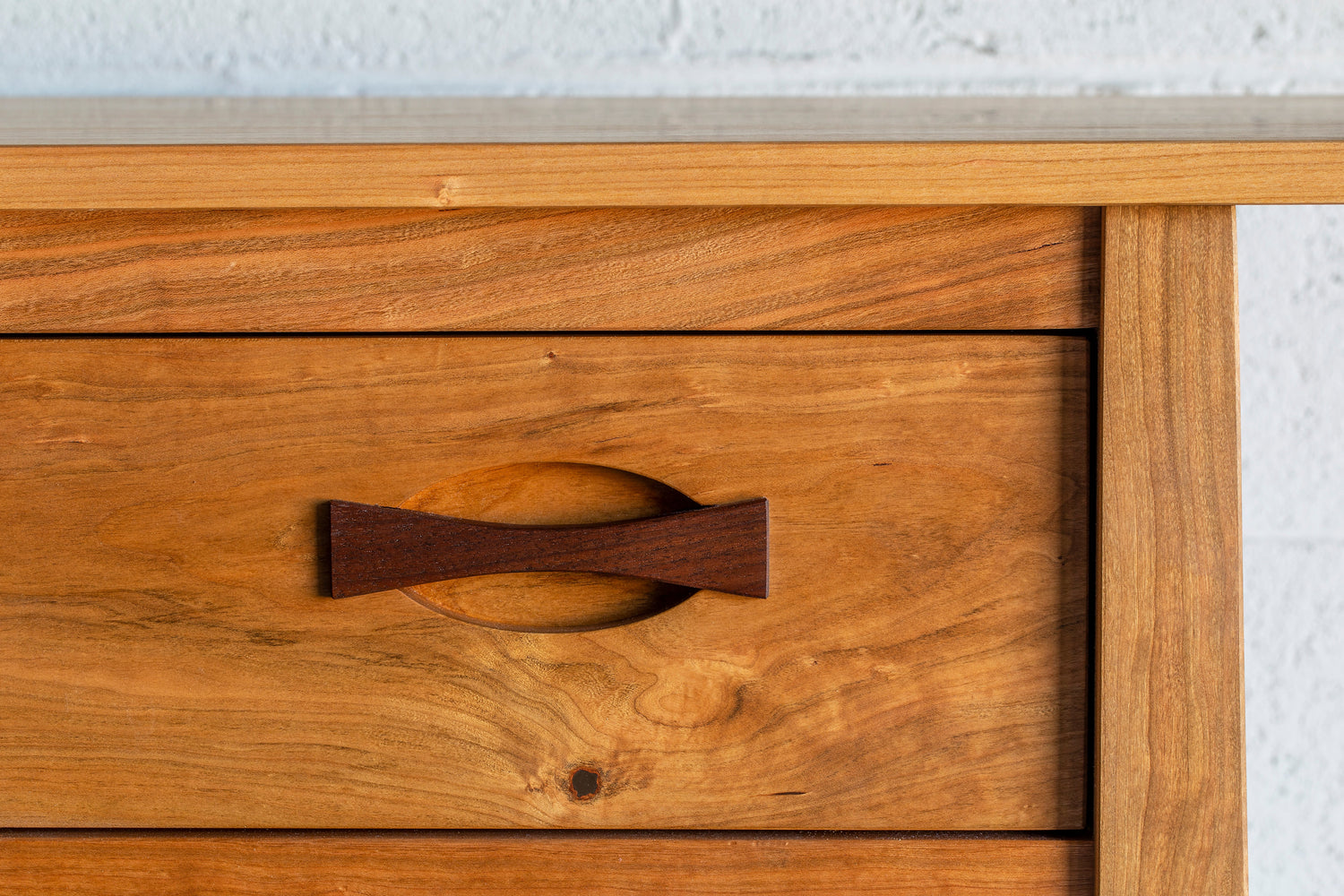
Enso Buffet in cherry wood with walnut handles. Explore T.Y. Fine Furniture's Dining Collection.
Quartersawn Cherry Lumber
Regular lumber is typically cut straight through the log, parallel to the pith. Quarter-sawn cherry, on the other hand, highlights the wood's unique properties. It is done by cutting the log into quarters at an angle against the grain. This creates boards with vertical growth rings rather than horizontal ones.
Using quarter-sawn cherry wood offers several advantages. One major benefit is its stability, as the vertical growth rings make it less likely to warp, cup, or twist over time. This makes it ideal for applications requiring dimensional stability, like doors, drawer fronts, and tabletops. Moreover, quarter-sawn cherry wood has greater overall strength compared to plain-sawn cherry due to its grain orientation.
Quarter-sawn cherry is also more beautiful. The vertical growth rings create a beautiful, straight grain pattern with a subtle, striped appearance.
See the beauty of cherry wood before you order our handcrafted furniture. Get a wood sample today ➝
Things You Need to Know About Natural Cherry Wood
When we talk about cherry wood, we’re referring to the American Black Cherry Tree, scientific name Prunus serotina, as the source. This wood species can potentially grow up to 100 feet tall and reach up to 5 feet in diameter, but the size varies, depending on the environment it grows in.
Cherry wood thrives in many parts of North America and South America, but we source ours specifically in Ohio, from sustainably managed forests.
Natural Cherry Wood Changes Color
As it ages, natural cherry wood changes color – it darkens over time. It is light and pinkish when freshly cut, and in the first six months of exposure to sunlight, the color of cherry wood may change from pinkish brown to a warmer reddish-brown. But it may take years, about five or more, before the color changes into the signature cherry wood color, a gorgeous red-brown.
Opinions are divided on cherry wood's transformation as it ages. Some prefer the lighter shade of reddish brown. To us, the beauty of cherry wood comes out when the wood matures and develops a gorgeous patina. These features add warmth and character to furniture, making a piece look more “antique” and valuable.
Cherry Is a Workable Wood
Many furniture makers, T.Y. Fine Furniture included, love to work with cherry because it is a workable hardwood. On the Janka Hardness Rating Scale, black cherry scored 990-995, which means it is a hardy material that is durable enough to withstand the wear and tear from normal use as furniture. At the same time, it is also relatively easier to work with machines, chisels, nails, and screws, among other tools.
Check out the Modern Dresser and the Apollo Dresser in Cherry.


Cherry Wood is Typically Smooth and Straight-Grained
Cherry wood has a smooth texture and a straight, closed-grain pattern that is similar to maple wood. But we don’t expect uniformity in wood grains, even when the material comes from the same tree. Tree maturity mainly contributes to the grain pattern of natural wood. Pith flecks or worm tracks also create these brown streaks on the grain. Other things like mineral deposits and gum pockets affect the way the grain looks as well.
“Cherry” Stains and Finishes
Many people are confused about the color of cherry wood because so many manufacturers are passing off low-grade wood that is finished with an unnatural dark maroon stain as ‘cherry color’, and even in some cases, ‘dark cherry color’. But natural cherry is a medium-to-dark reddish brown, with some variations across the surface, something that a low-quality stain cannot compete with.
Distinguishing Real Cherry Wood Furniture
It is challenging to distinguish wood types based on appearance alone, especially if the furniture has been stained. Plus, a variety of woods have similar grain patterns, so it really is difficult to identify the material by just looking at the color and the grain.
Buying furniture crafted by your local artisans is one of the most reasonable ways to ensure that your furniture is made from real cherry wood. Small-scale furniture makers are more hands-on with the process and tend to use natural solid wood.
Cherry Wood FAQs
Is cherry a good wood?
Yes, cherry is a good wood—one of the most sought-after hardwoods for fine furniture. It is not only durable but also beautiful, with a unique color transition from light reddish-brown to a deeper, richer shade that settles in over about five years.
How rare is cherry wood?
Cherry wood isn't rare; it's a common, domestic hardwood. As of writing, the species is not listed on the CITES Appendices or the IUCN Red List of Threatened Species, meaning its population is secure and it is not endangered.
That said, it's relatively scarce in the sense that it isn't harvested or used (for different purposes) as often as woods like pine.
Is cherry wood expensive?
Cherry wood costs more than common woods like pine, ranking as a premium domestic hardwood. But it's typically less costly than white oak, walnut, or exotic hardwoods like mahogany. In our collections, cherry and hard maple generally fall in the same price range, while walnut and white oak run higher.
How can you identify genuine cherry wood products?
Real cherry wood doesn't feature perfect uniformity, which is often a sign of a printed pattern or a heavily stained substitute. As a natural hardwood, cherry has an organic character that's hard to mimic: subtle shifts in the grain and slight variations in pattern and color. For furniture, always check the end grain—the cross-section where the wood was cut across the growth rings—since it reveals the wood's true grain structure in a way a printed or stained surface can't replicate. You can find it at the edges of furniture.
How dark is cherry wood?
Cherry wood is a warm reddish-brown, considered a medium-dark tone. It's not as pale as maple or white oak, but not as dark as walnut or mahogany.
What does old cherry wood look like?
Old cherry wood deepens into a reddish-brown with warm undertones and develops a natural luster over time. In furniture finished with an oil-based finish and no added stain, the wood surface builds a patina.
Is cherry wood cheaper than oak?
It depends on the type of oak. In our case, cherry wood furniture is typically less costly than white oak.
Is cherry wood furniture out of style?
No, cherry wood furniture isn't out of style. Cherry as a material is timeless. Its warm, natural color transcends passing trends. What can feel dated is the design and finish. A lot of "cherry" furniture isn't even made from natural cherry, but some type of wood that's stained with a reddish, magenta-tinged color that people often associate with bulky, traditional pieces. When cherry furniture is designed with clean lines and a simple silhouette, it stays timeless.
Which is better, cherry or mahogany?
"True mahogany" is considered endangered or vulnerable, making black cherry the better choice for furniture when natural domestic availability matters.
Big-leaf mahogany (Swietenia macrophylla), the primary genuine mahogany species used in fine furniture, and Cuban mahogany (Swietenia mahagoni), prized for antique colonial pieces, are both listed by the IUCN as endangered or threatened.
Originally published on August 11, 2022, this post has been updated.