

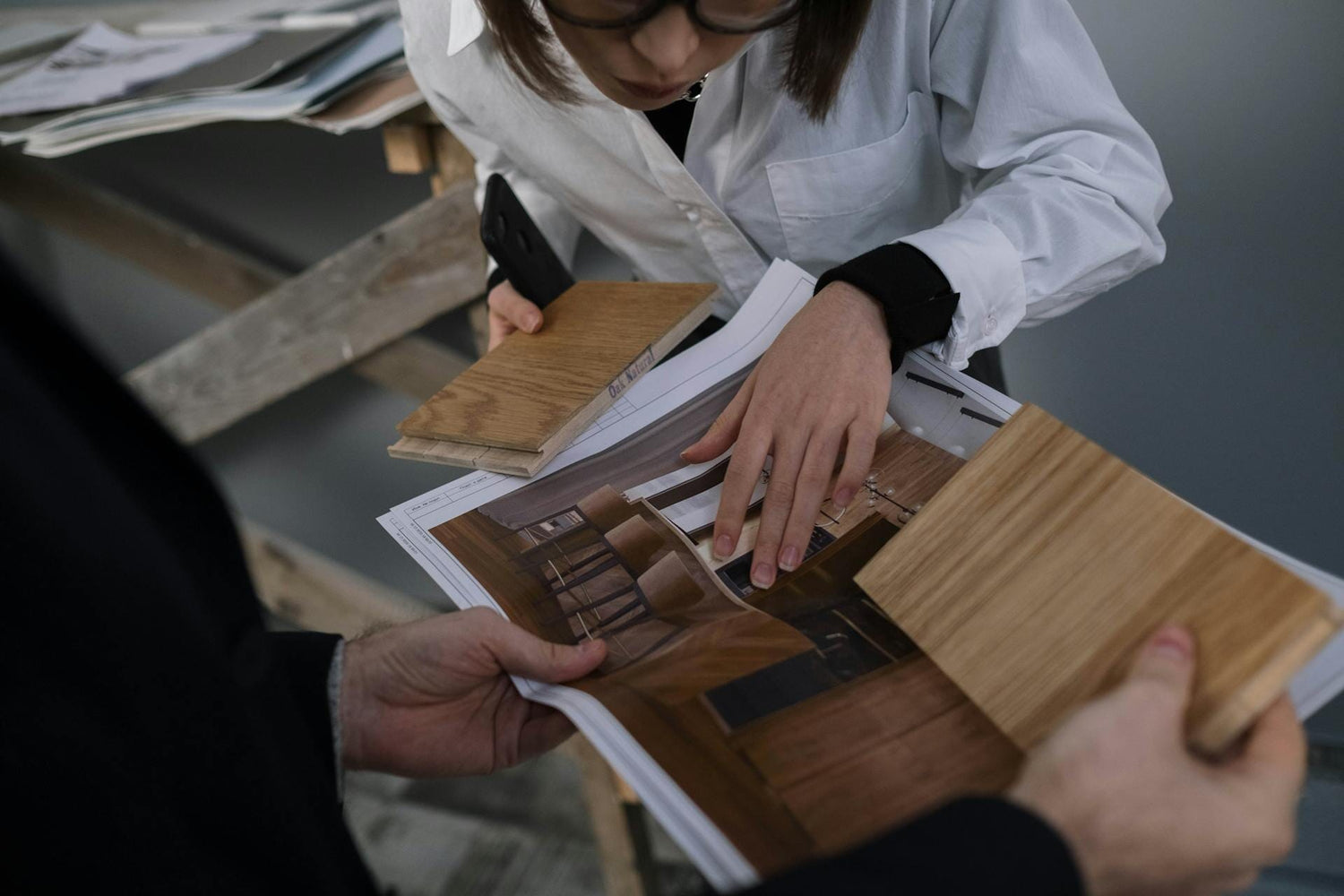
Walk into a big-box furniture store, and you'll see "wood furniture" everywhere. But what does "wood" actually mean?
When retailers say "wood finish," they often mean plastic laminate. "Real wood veneer" often reveals nothing about the cheap core underneath. And when they just say "wood"? That could be anything.
So what are you really buying? Solid hardwood that lasts more than 50 years? Thin veneer over plywood? Printed plastic designed to look like wood?
The furniture industry uses vague language to sound premium. But the difference between solid wood, veneer, and laminate isn't just about marketing. It's the difference between furniture that graces your home for decades and furniture that ends up in a landfill after seven years.
Learning to spot the difference takes five minutes. That knowledge saves thousands of dollars.
This guide shows you how to identify each material in stores, decode the pros and cons, and choose furniture that offers you the best value for your needs and budget.
Solid Wood, Laminate, and Veneer
Have you ever wondered what your furniture is really made of? With so many different materials available, it can be confusing to determine what's best for your home. Let's clear up the confusion and explore the differences between these popular furniture materials.
Solid Wood
Solid wood furniture refers to pieces constructed entirely from real wood, not veneer over particle board, not laminate pretending to be wood. Every visible surface, every drawer box, every shelf is genuine hardwood.
As it usually goes for things made from natural materials, natural hardwood tends to be pricier than other furniture material options. But its durability ensures it can withstand the test of time, often outlasting the people who buy it.
Solid Wood Furniture Features
- The entire piece is crafted from natural hardwood species such as White Oak, Walnut, Hard Maple, and Black Cherry.
- Every visible surface is real hardwood.
- Internal components like drawer boxes and shelves are also solid.
- No particleboard, MDF, or composite materials.
- Grain runs continuously through the thickness.
Pros of Solid Wood Furniture
1. Durable
Solid wood furniture is very durable and can last for decades, even with heavy use. Unlike mass-produced alternatives, it ages gracefully and can serve homes for decades, especially with proper care.
This durability comes from natural hardwood’s dense cellular structure, which provides natural strength and flexibility. It absorbs impact without cracking and supports heavy loads without sagging. When paired with proper joinery, a solid wood piece can resist structural failure that often happens with aging.
2. Beautiful
Furniture made from real hardwood has a natural beauty that is simply unmatched by other materials. The distinct grain of the wood gives each piece its own unique character, transforming solid wood furniture into individual works of art.
No two pieces made from solid wood are identical, even when they share the same design. Each board can showcase variations in grain pattern and color, including character marks—mineral streaks, knots, figures, and burls—even with boards cut from the same tree.
3. Long-Term Value
Built to handle daily use, solid wood pieces offer lasting performance that cheaper materials just can't match, making them a better value over time.
One of the best things about solid wood furniture is that it can be renewed. You can sand it down and refinish it multiple times—often five to ten or more over its lifespan—so you can refresh the piece rather than replace it. And if something does get damaged, solid wood can usually be repaired, whether it's scratches, dents, or even more serious structural problems.
Solid wood furniture also holds its value remarkably well, often retaining 50–70% of its original price if you decide to resell it. Many people say it actually gets better with age, developing character and patina instead of falling apart, which just reinforces why it's such a practical, long-term investment.
Cons of Solid Wood Furniture
1. Expensive
Solid wood furniture is typically more expensive than other types of furniture materials, such as wood veneer or particleboard. The cost reflects the quality of the lumber, the level of craftsmanship involved, and the inherent value of the natural material.
Why solid wood costs more: Premium lumber, particularly FAS-grade hardwood, forms the foundation of quality pieces. Skilled labor is required for traditional joinery, and the time-intensive construction process cannot be rushed. Multiple finish coats are carefully applied, often by hand. Additionally, responsible forestry and sustainable sourcing practices add to the overall investment.
Typical price ranges vary based on quality and craftsmanship. Budget solid wood pieces generally fall between $800-1,500, while heirloom quality pieces—those built to last generations—typically start at $2,000 and can exceed $10,000.
2. Heavy
One downside of solid wood furniture is that it can be heavy and hard to move. Solid wood is generally heavy due to its high density and natural composition, making it significantly heavier and more durable than engineered alternatives like particleboard or MDF.
However, the strength and durability of natural wood can outweigh this minor inconvenience. Plus, with some good planning, you can easily overcome this slight disadvantage.
Why weight matters: The heft of solid wood furniture actually indicates quality construction. It provides stability and sturdiness, making pieces less likely to tip or wobble. That substantial weight also contributes to the valuable, well-made feel that sets solid wood apart from lighter alternatives.
3. Maintenance
Solid wood furniture requires some regular maintenance, such as polishing and waxing, but it's far less demanding than the internet sometimes suggests.
Actual maintenance requirements are quite manageable, and here are some tips:
- Dust regularly with a soft, dry cloth to keep surfaces clean.
- Apply furniture oil or wax 2-4 times per year to maintain the finish and protect the wood.
- Wipe up spills immediately to prevent staining or damage.
- Keep furniture away from direct heat sources like radiators or fireplaces, and try to maintain 40-60% humidity in your home to prevent cracking or warping.
- Use coasters and placemats to prevent water rings on surfaces.
While solid wood does require some care, a quality wood finish protects the wood and makes maintenance straightforward.
See the quality for yourself. Order your curated sample pack of White Oak, Walnut, Maple, and Cherry to find the perfect match for your space. Get wood samples here.

Veneer
Veneer furniture is made from thin slices of real wood—typically 1/42" to 1/16" thick—glued to a substrate, such as plywood, MDF, or particleboard. Take note that veneers are authentic wood, not synthetic materials designed to resemble wood. That's laminate.
Wood veneer is typically more affordable than real hardwood but can still be relatively durable and attractive, depending entirely on what's underneath that thin wood layer.
Veneer Furniture Features
The veneer layer:
- Thin slice of real wood shaved from a log
- Applied to a core material (substrate)
- Can be made from expensive or exotic woods
- Allows for book-matching and decorative patterns
- Thickness varies from paper-thin to 1/16"
Common substrate materials:
- Plywood, often considered the best option among solid wood alternatives, is made of thin layers of wood veneer glued together in alternating grain directions, making it stable and strong.
- Medium-Density Fiberboard or MDF is composed of wood fibers bonded together with resin under heat and pressure, creating a smooth, dense panel.
- Particle board, the cheapest and least durable option, is made from wood chips, sawdust, and adhesive pressed into sheets.
Pros of Veneer Furniture
1. Relatively Affordable
Veneer furniture generally tends to be more affordable than solid wood furniture, making it a suitable option for budget-conscious shoppers. That said, quality veneer isn't exactly cheap either. Depending on the wood species used, wood veneer can even cost more than solid wood.
Here's the main reason why wood veneer costs less: it uses less premium hardwood. One log can produce many thin veneer sheets. The substrate or core underneath—typically plywood, particle board, or another hardwood species—is cheaper than solid lumber. Veneer also allows manufacturers to use sought-after wood species economically.
To give you an idea, here's a price comparison for a wooden dresser: Solid wood runs $1,500-5,000 or more, while high-quality veneer over plywood typically costs $800-2,000. Cheap veneer over particle board drops to $300-800, though durability suffers at that price point.
2. Durable
Wood veneer can be durable, especially when made with high-quality materials and construction. Sometimes, compared to solid wood furniture, veneer furniture is less prone to warping or cracking on large flat surfaces.
When wood veneer is durable:
- Thick veneer, around 1/16" rather than paper-thin
- Applied to plywood or solid wood core
- Properly sealed edges prevent moisture penetration
- Quality construction with good joinery
- Well-maintained and protected from heat and moisture
3. Versatile
From a design standpoint, wood veneers offer plenty of room to play around with specific styles. They allow for intricate details that are often quite challenging to pull off with solid wood alone. Techniques like book-matching, for instance, create beautiful, symmetrical grain patterns, making it easier to maintain consistent color matching across large surfaces.
Cons of Wood Veneer Furniture
1. Durability Concerns
Wood veneer furniture is generally durable if well-constructed. But it's still more susceptible to damage than solid wood, particularly from moisture and heat.
Common failure points include edges where veneer can lift or peel, moisture exposure that may cause bubbling or swelling of the substrate, and heat that can soften adhesives and lead to separation. Impact damage can dent the underlying material and crack the veneer surface, and once compromised, the veneer layer is difficult to repair without visible signs of damage.
2. Challenging to Repair
When veneer furniture gets damaged, repairs are often difficult, costly, and sometimes simply impractical. Because the veneer layer is thin, it can’t be sanded down extensively like solid wood, meaning even minor surface damage can permanently change how a piece looks. Matching the original grain and color is a real challenge, and re-gluing lifted edges requires a high level of skill to avoid visible seams or uneven spots.
The potential for a successful fix also depends heavily on the substrate underneath. Pieces with a plywood core can sometimes be repaired fairly well, while particle board cores are usually beyond saving once they’re damaged. MDF falls somewhere in between, offering a few limited options for repairs.
3. Aesthetic Limits
While veneer can certainly be attractive, it often lacks the inherent depth and character found in solid pieces.
Choosing veneer usually involves a few trade-offs. For one, it can't really be refinished, since even light sanding can cut right through that thin top layer. So, giving it a makeover later on can be a struggle. The edges also tend to give it away, breaking the illusion that the piece is solid wood. Moreover, it won't develop that rich, natural patina that solid wood gains over time, and the grain can feel a bit flat since it’s just a surface layer.
Laminate
Laminate furniture is not made from real wood and can be easily identified as artificial due to its glossy plastic finish. The wood-like appearance of laminate is achieved through a printing process—a photograph of wood grain printed on plastic sheet, sealed with clear plastic (melamine), and glued to MDF or particle board.
Plastic Laminate Composition
- Photograph or pattern of wood grain printed on plastic
- Clear plastic (melamine) protective top layer
- Heat and pressure-bonded to the substrate
- Substrate is usually MDF or particle board
Pros of Laminate Furniture
1. Affordable and Accessible
When it comes to the price tag, laminate furniture is typically the most budget-friendly choice, often costing significantly less than veneer or solid wood. The reason it’s so much cheaper essentially comes down to the materials and how they’re made.
Since there’s no actual wood involved (aside from the wood fibers in the core), the costs are kept low. The decorative patterns are just printed, which costs pennies compared to real timber. Plus, the entire process is designed for mass production with minimal labor, the very reason why its widely available.
To give you a better idea of the price gap, here’s how a standard dresser usually compares across the three materials:
- Laminate: $200-600
- Veneer: $500-1,500
- Solid wood: $1,500-5,000+
2. Easy to Maintain Surface
Laminate furniture is very low-maintenance, usually requiring nothing more than a quick wipe to clean it. The surface is actually quite resistant to scratches, water rings, and heat marks. It also doesn't need refinishing or the kind of upkeep that real wood needs.
How well it holds up long-term mostly depends on its construction. High-pressure laminate (HPL) on a thick MDF substrate is much tougher than low-pressure versions built on particle board, especially when the edges are sealed well to keep moisture away.
3. Variety
Laminate furniture offers a huge range of colors, finishes, and styles, making it easy to find something that fits into just about any decor. Since it's so widely available, you're never short on options.
Its real strength lies in its design flexibility; because the surface is essentially a printed layer, it can mimic everything from rare, expensive wood species to high-gloss solids and even custom patterns or graphics that just aren't possible with real wood.

The photo shows the surface of a damaged plastic laminate. The plastic laminate cracked, revealing the particleboard underneath.
Cons of Laminate Furniture
1. Looks Artificial
While laminate is incredibly versatile, it simply can't compete with the look and feel of natural solid wood. For many, it simply lacks that genuine quality, mainly because it's essentially a printed image.
The artificial nature of laminate furniture is pretty obvious. The edges reveal a printed layer rather than a continuous wood grain, and the perfectly uniform color lacks the unique variations that give real wood its character. It also doesn't age or develop a rich patina over time. Even the "feel" is different and often has a hollow sound when tapped.
2. Difficult to Repair
Laminate furniture is essentially single-use. Because the surface is a thin plastic layer, it’s prone to issues that are almost impossible to fix properly. Once moisture finds its way past that layer and into the core, the piece is pretty much done for. While touch-up pens and fill sticks might help hide a scratch for a bit, they’re really just temporary cosmetic fixes at best.
Most laminate failures happen at the structural level. If you chip an edge, it exposes the "ugly" core beneath, and any hard impact can dent the substrate, causing the brittle laminate surface to crack. Moisture is the biggest enemy, though, as it causes the MDF or particle board core to swell and warp.
3. Sustainability Concerns
Laminate furniture raises sustainability concerns, mainly because it's mostly made from petroleum-based materials. The surface layers are essentially plastic or melamine derived from non-renewable resources, while the MDF or particle board cores typically rely on formaldehyde-based glues. This often leads to the off-gassing of VOCs (volatile organic compounds), which can affect indoor air quality.
Plastic laminate's short lifespan contributes heavily to the waste cycle. Unlike solid wood, which can be passed down for generations, laminate is generally not recyclable through standard recycling programs. Because it consists of inseparable layers of plastic, paper, and adhesive-laden board, these mixed materials and chemical coatings mean most pieces are destined for a landfill once they've reached the end of their useful life. To recycle is effectively, plastic laminate furniture needs to be sent to specialized facilities.
Read more about the dangers of fast furniture:
- The Billion-Dollar Furniture Waste Problem | Green America
- Fast Furniture Is an Environmental Fiasco | The New Republic
- Durable Goods: Product-Specific Data | US EPA
Complete Material Comparison
| Feature | Solid Wood | Veneer | Laminate |
|---|---|---|---|
| Material | 100% natural hardwood lumber | Thin wood slice on substrate | Printed plastic on MDF/particle board |
| Thickness | 3/4" - 1"+ full thickness | 1/42" - 1/16" wood layer | Paper-thin printed layer |
| Appearance | Unique grain, natural variation | Real wood grain, more uniform | Printed pattern, repeats |
| Authenticity | Completely genuine | Real wood surface only | Not real wood |
| Durability | Excellent, 50-100+ years | Good to fair, 15-30 years | Fair to poor, 5-15 years |
| Repairability | Excellent, can sand/refinish 5-10+ times | Limited, can't sand through veneer | None, cannot repair |
| Weight | Heavy (150-300 lbs dresser) | Medium to Heavy (100-180 lbs dresser) | Light (80-120 lbs dresser) |
| Moisture Resistance | Good with proper finish | Poor to fair, depends on core | Fair, but core swells if penetrated |
| Heat Resistance | Excellent | Fair, can damage veneer/glue | Poor, can blister or melt |
| Refinishing | Yes, multiple times | Yes, very light sanding, depending on thickness | No, cannot sand |
| Resale Value | 50-70% of original | 10-30% of original | 0-10% of original |
| Environmental | Renewable source, biodegradable | Mixed, depends on core | Poor, petroleum-based |
| Maintenance | Regular oiling/waxing | Minimal, protect from moisture | Very low, just wipe clean |
| Cost (Dresser) | $1,500-5,000+ | $500-1,500 (quality) / $300-800 (cheap) | $200-600 |
| Lifespan | 50-100+ years | 15-30 years (plywood) / 7-15 years (particle board) | 5-15 years |
| Best For | Heirloom pieces, permanent homes | Budget-conscious option, | Temporary furniture, rentals |
Takeaway
Deciding between laminate, veneer, and natural hardwood really comes down to your personal priorities and how you plan to use the piece.
While laminate is the obvious budget-friendly choice, there’s a strong case to be made for investing in natural hardwood. Solid wood pieces are definitely more expensive upfront, but they function more like a long-term investment. They pay off over time because you likely won't ever need to replace them unless they’re completely destroyed—which is pretty rare. Most issues can be fixed with a simple repair, and the piece will actually hold its value, allowing you to resell it or pass it down as an heirloom.
Basically, your choice depends on what kind of lifecycle you want for your furniture:
- Laminate = Best for short-term convenience and minimal upfront investment, provided you're okay with a replacement cycle
- Veneer = A solid middle ground that offers real wood authenticity and moderate longevity, especially if it has a high-quality core
- Solid Wood = A one-time purchase intended for the long haul, offering heirloom potential and the best overall value over decades
Think about your current budget reality, but also consider how long you want that piece to be part of your life.
Featured photo by cottonbro studio from Pexels


