Hard maple and walnut are among our favorite woods to work with, and they’re easily among the most beloved materials in furniture making. As domestic hardwoods, they’re accessible to local craftspeople, and not only that, but both are durable, dependable, and beautiful in their own distinct ways.
At first glance, maple and walnut couldn’t be more different. One is light while the other is dark. While they sit on opposite ends of the color spectrum, they share a reputation for premium quality. Whichever material you decide on, you really can’t go wrong, especially if the furniture is crafted well. That said, choosing between maple and walnut wood furniture involves more than color alone. Each wood has its own distinct features, and knowing them can help you narrow down your search. And that’s what we’re here to explore.
Color and Grain: Maple vs Walnut
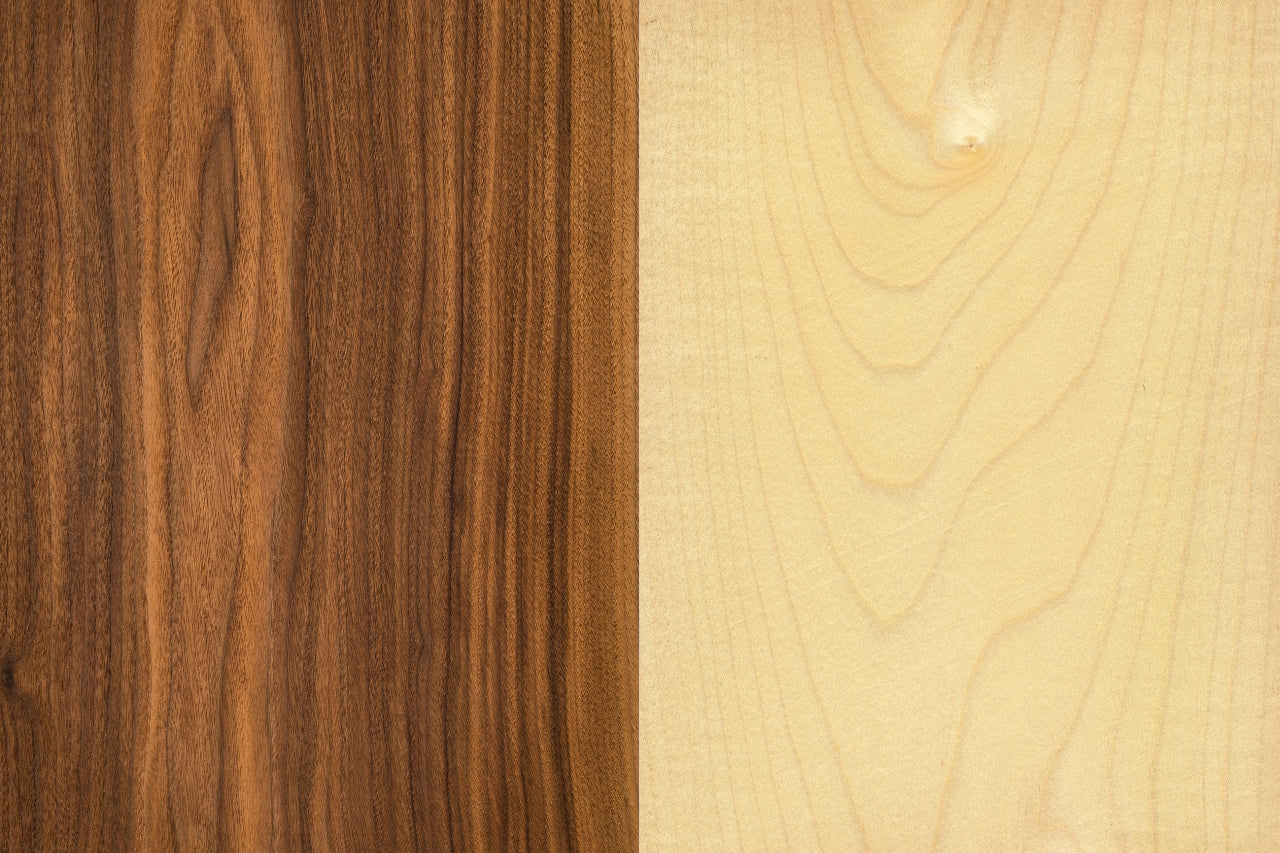
The first thing you’ll notice about these two woods is the color. Maple is light while walnut is dark, and this contrast greatly affects the furniture’s overall feel.
Hard maple ranges from creamy white to a very light brown, with a subtle, consistent grain pattern that gives it a bright, clean look. Its understated appearance is part of what makes it so versatile. Sometimes maple develops unique figured patterns, the most famous of which are small swirling formations known as bird’s eye, which resemble tiny birds’ eyes scattered across the surface.
Walnut wood, meanwhile, is known for its dark brown color, sometimes with slight hints of purplish or reddish undertone. The grain is generally straight, but natural waves, curls, and knots create distinctive pattern variations from board to board. Rather than looking uniform, walnut wood tends to appear dramatic and full of character.
At a glance:
✤ Maple is creamy white to light golden brown, with subtle and consistent grain, although occasionally figured (bird's eye).
✤ Walnut is a rich dark brown with purple or reddish undertones, tight, straight grain with occasional waves, curls, and knots.
| Species | Maple | Walnut |
|---|---|---|
| Scientific Name | Acer saccharum (Sugar Maple) | Juglans nigra (Black Walnut) |
| Color | Creamy white to light golden brown | Rich chocolate brown, often with purple or reddish undertones |
| Grain Pattern | Subtle, consistent, occasionally figured | Tight and straight with frequent natural variation — waves, curls, knots |
| Janka Hardness | ~1,450 (very hard) | ~1,010 (hard, slightly softer) |
Hardness and Durability: Maple vs Walnut
Both woods are durable. That's not up for debate. But they do differ in hardness, and it's worth understanding what that means in practice.
Maple is one of the hardest woods commonly used in furniture, with a Janka hardness rating of around 1,450. It's dense, highly resistant to dents and scratches, and exceptionally well-suited for pieces that see daily use or heavy wear. If longevity under pressure is your priority, maple is hard to beat.
Walnut comes in at around 1,010 on the Janka scale—still solidly in "hard" wood territory, but slightly softer than maple. This means it can be more susceptible to dents under significant impact. However, and this is important, the quality of the craftsmanship matters just as much as the raw material.
A master craftsman who understands how walnut behaves will produce a piece that's not only beautiful but genuinely long-lasting. The wood's properties are only part of the equation; knowing how to work with it is the other. With proper care, walnut furniture holds up beautifully for generations, just as long as maple furniture.
At a glance:
✤ Maple: Janka ~1,450, extremely hard, highly scratch-and-dent-resistant, ideal for high-use pieces
✤ Walnut: Janka ~1,010, hard and durable, best results come from skilled craftsmanship and proper care
Cost: Maple vs Walnut
In most cases, walnut is the pricier of the two. Part of that comes down to supply and demand. Black walnut trees are less abundant, and the wood's rich color and dramatic grain make it especially desirable for premium wood furniture.
Hard maple is typically more affordable, but that doesn't make it a lesser wood. Many high-end furniture makers actually prefer it for its strength, stability, and clean aesthetic. The price difference really comes down to appearance and rarity, not overall quality. Both woods belong firmly in the premium hardwood category.

Choosing the right wood for your home is a tactile experience. Order our solid wood sample pack today to see exactly how walnut wood and maple wood look in your room's natural light.
Best Style Pairings: Maple and Walnut
We would argue that both maple and walnut are versatile enough to work in almost any interior style when used in clean, timeless furniture designs.
Still, over time, we’ve noticed certain preferences in how people tend to use these woods in different spaces.
Maple lends itself naturally to Scandinavian, minimalist, and modern interiors. Its light, clean appearance keeps spaces feeling open and airy. It works especially well in rooms that rely on natural light or lean toward neutral, understated palettes.
Walnut is the go-to for statement pieces. It works beautifully across a wide range—from traditional to contemporary—and tends to anchor a room with warmth and depth. It's a popular choice for dining tables, desks, and living room pieces where the wood's character can truly be appreciated.
That said, both woods are more adaptable than their reputations suggest. Don't let style rules box you in.
Maple and Walnut FAQs
Which is better for furniture, maple or walnut?
Neither is "better". They are both durable, top-tier hardwoods. This means that your choice would depend on your color preference and how much "character" you want in the wood grain.
Can maple be stained to look like walnut?
Technically, yes, but we don't usually recommend it. Staining maple can mimic the color, but it can’t replicate walnut's unique grain depth and natural variations. If you love the look of walnut, we suggest going for the real thing; the investment is worth getting the look you truly prefer.
What's usually more expensive, maple or walnut?
Walnut, generally. But as mentioned above, maple is not the "lesser" choice because it costs less. The difference is mostly about availability and its high demand in premium hardwood furniture.
Do walnut and maple go together?
They can, and actually quite beautifully, with the right design approach. Mixed-wood interiors—pairing light and dark wood pieces—add visual interest and depth to a space in a way that all-matching sets sometimes don't. Our own Tulip Table is a great example: it features a maple base paired with a walnut tabletop, and the contrast is part of what makes it special.
What shade is walnut?
Walnut ranges from a medium to deep chocolate brown, often with subtle undertones of purple, grey, or warm red running through it. The exact tone varies naturally from piece to piece, which is part of its charm.
What color is close to maple?
Maple sits in the creamy white to light golden brown range—think warm ivory or pale honey. Light ash and certain cuts of birch are visually similar, though maple has its own distinct grain character.
Which furniture brands specialize in maple and walnut furniture?
For solid hardwood furniture made to last, T.Y. Fine Furniture is one worth considering. Both maple and walnut are central to our furniture collection. Our team crafts each piece with care and protects it with our organic wood finish that emphasizes the natural beauty of these hardwoods.